Showing posts with label Alfred Hitchcock Mystery Magazine. Show all posts

The Hitchcock Project: About Emily Neff--A Few Words About a Forgotten Mystery Writer

Emily Neff
In my review of "One for the Road," I wrote that I had been unable to find any information about Emily Neff, the author of "Partner in Crime," the short story upon which that episode was based. However, I have recently made contact with Susan Bernard Voelker, the daughter of Emily Neff. Ms. Voelker was kind enough to provide details about her mother.

Emily Neff

by Susan Bernard Voelker

My mother, Emily Neff Bernard, was born in Denton, Texas, on September 22, 1922, to Sherman Brown Neff and Jessie Utz Neff. She had a younger brother, Phillip Duncan Neff. She was born Emily Neff, no middle name.

She came from a literary family. Her father had a bachelor’s and master’s degree from Yale, and a master’s and doctor’s degree from Harvard. Most of his life was devoted to college administrative work and teaching. For twenty-five years, Dr. Neff was the head of the Department of English at the University of Utah. After he retired, he went to Wayland College in Plainview, Texas, as chairman of the Division of Humanities and professor of English. He was much loved and revered by his students. He was the author of two books, The Province of Art: An Approach Through Literature, and Lazarus and Other Poems. He was listed in Who’s Who In America.

Emily’s mother was the youngest of ten children and grew up on a farm in Missouri. At age eighteen she got her teaching certificate and taught for a year in a one-room, one-teacher school. She wrote her memoirs about her life on the farm, but I have no information on college and career. She and my grandfather were avid readers, and passed on their love of books to my mother.

Her first story, "Hoolio," was published here
My mother grew up in Salt Lake City, Utah. I believe she started writing at an early age. I have a little blue enamel vase she was awarded in 1936 (age fourteen) by the William M. Stewart School for "first prize, short story." After high school she went east, to Smith College, where she earned a B.A.­ with a major in English. She spent her junior year at the University of Utah, where she joined Kappa Kappa Gamma.

Initially she was interested in newspaper writing. For one year she was a reporter for the New Britain Daily Herald, but she wanted very much to move to New Orleans and work for the Times-Picayune. Her plan was to start out in New Orleans and then move on to San Antonio and San Francisco. I have a series of humorous letters between her and the managing editor of the T-P, where she is trying to convince him to hire her in spite of her inexperience, out-of-state status, and the fact that she was a "girl reporter." These letters are all signed with her nickname, Red Neff. A quote from one of her last letters: "I seem to be beating my head against a stone wall in trying to land a mail-order job on your paper. However, being too young to be discouraged, too mulish to give up, and too dumb to know when I’m licked, I shall continue to cling to the thread of hope you have extended." Eventually, she went to New Orleans, had an interview, and was hired. She never made it to San Antonio or San Francisco, because she met my father, Pierre Victor Bernard, who was a city editor on the paper, got married and had three daughters. All her life, she loved New Orleans.

"The Baby Sitter" was
published in this issue
Emily was a reporter for the Times-Picayune for two years. Over the next two decades, her fiction writing was sporadic, not prolific. Perhaps the reason it is difficult to find out anything about her is that she didn’t seek recognition and wrote more as a hobby than anything else. Her genre was the short story, but she wrote some clever little poems, and even once collaborated with a friend on a musical, which they didn’t finish. She wrote the lyrics and her friend the music. A favorite of mine was a children’s story called "Garfield, The Absent-Minded Goat," which was never published, and I’m not sure she even submitted it. A list of her writings, the ones I know of, is attached.

I’m pretty sure the stories that Alfred Hitchcock bought were all originally published in magazines, and I believe he bought them through her agent in New York, McIntosh and Otis. I don’t think my mother ever had any personal contact with Hitchcock. Of course, she was delighted he used her stories on his show, and it was always a source of pride in our family. Still is.

My mother stopped writing some time in the 70’s, I think, when she became increasingly interested in New Orleans politics. She started her own public relations firm, with mostly political accounts. My older sister worked with her, and, when Emily retired, my sister took over the business.

"The Chrysalis" was published here
When we were growing up, my mother was popular with our friends, who saw her as talented, glamorous, and hip. She was active in our schooling. She directed several plays when I was a Brownie and produced and directed talent shows at our high school. She taught sewing to the neighborhood children, and one summer she helped me and a friend write a neighborhood newspaper (The Nosy News).

My older sister and I both majored in English. Neither of us followed in our mother’s footsteps. Although we didn’t write creatively, except for a few poems here and there, our background in English helped us in writing various articles/reports for our jobs, my sister in public relations and advertising, and me in social work. My younger sister was an art major, creative in another way.

Emily liked to travel… the UK, Europe, Russia, India, Mexico, Jamaica. Italy was her favorite, and she took classes to learn the language.

It was Emily’s wish to make it to the year 2000, but she fell a few months short. She died of a stroke on August 22, 1999, in Mandeville, Louisiana, across Lake Pontchartrain from New Orleans. She was seventy-six. At her memorial service, I read from the last chapter of Eudora Welty’s One Writer’s Beginnings, which I had been reading to her when she was sick. We scattered her ashes in her beloved Bryce Canyon, Utah.

I asked my friends who knew her to tell me the first word or words that came to mind when thinking about my mother. These are the words: red, red lipstick and hair, intellectual, intimidating, haughty, elegant, reserved, critical, stubborn, intelligent.


Ms. Voelker's husband, Tom Voelker, also was kind enough to share his memories of Emily Neff:
"Mr. Blanchard's Secret"
was published here

What about Emily?

I could never pin her down.

Creative. Insightful. Intelligent. Emily.

She could be charming. She could be dismissive. She could be engaging or remote, at once inviting and unapproachable.

Her smiles played across subtle wit, thoughtful observation, and cutting sarcasm.

In Emily, strength of character shaded over into hard willfulness.

But it wasn’t just that she was self-centered. Her center was her self.

Like all of us, there was much more to Emily than what met the eye.

To me, she was a mystery. Something essential remained hidden: the center.

She eluded me.

I never saw more than a few facets of her infinite variety.

I wonder whether anyone did.


Short stories by Emily Neff

"Hoolio," Seventeen, May 1948
"The Other Man," The Times-Picayune Magazine, April 10, 1949
"The Chrysalis," Cosmopolitan, October 1952
"Pupa and Butterfly," Familie Journal, Feb. 12, 1953
"The Baby Sitter," Cosmopolitan, May 1953
"Standard of Loving," Toronto Star Weekly Magazine, December 8, 1956
"Partner in Crime," Wicked Women, 1960
"The Love Sportsman," Ellery Queen’s Mystery Magazine, May 1961
"No Bed of Roses," Alfred Hitchcock's Mystery Magazine, March 1977
"Mr. Blanchard’s Secret," Ellery Queen’s Mystery Magazine, June 1978


TV Shows Adapted from stories by Emily Neff:

"The Baby Sitter," Alfred Hitchcock Presents, May 6, 1956
"Mr. Blanchard's Secret," Alfred Hitchcock Presents, December 23, 1956
"One for the Road," Alfred Hitchcock Presents, March 3, 1957 ("Partner in Crime")
"Bed of Roses," The Alfred Hitchcock Hour, May 22, 1954 ("No Bed of Roses")
"Murder in Mind," Alfred Hitchcock Presents, January 28, 1989 ("Mr. Blanchard's Secret")


Sources:

FictionMags Index
Galactic Central
IMDb

The Hitchcock Project-Clark Howard Part Two: Night Fever [10.28] and Wrapup

by Jack Seabrook

Colleen Dewhurst as Nurse Hatch
Hospitalized after being shot in a holdup gone wrong, Gerry Walsh awakens to find himself being questioned by the police, who want him to tell them the location of George Cappo, his partner in crime. Captain Tevell wants to have Walsh transferred to the prison hospital for killing a cop but the doctor says the patient is too sick to move, so Tevell has him handcuffed to the bed, with round the clock guards and steel grilles on the windows. Nurse Alma Hatch, "an extremely plain girl" of about 27, is assigned to care for the prisoner round the clock.

In the days that follow, Walsh flatters Nurse Hatch, telling her that she has "'natural beauty'" and cultivating a relationship with her. He denies having killed the policeman and confesses to having fallen in love with her. After Tevell tells Walsh that he's headed for the electric chair unless he tells the police where to find his partner, Alma offers to help the prisoner and fakes his records so he can stay in the hospital for a few more days. She then agrees to escape with him and helps him prepare.

"One Way Out" was
first published here
When Walsh is well enough to move, Alma gives his guards drugged coffee to put them to sleep before helping him out of the hospital and driving him to a run-down neighborhood. They climb to an upstairs apartment, where Cappo admits them and a voluptuous blond welcomes Walsh, who quickly dismisses Alma. Recalling the many times she has been fooled by men, Alma descends the stairs and tells the waiting policemen where to find the killers.

In "One Way Out," which was first published in the February 1965 issue of Alfred Hitchcock's Mystery Magazine, Clark Howard makes the reader believe that Nurse Hatch is desperate and that she falls in love with the manipulative criminal Walsh, so the conclusion, where the nurse is revealed to have been in control of the situation, comes as a surprise. The producers of The Alfred Hitchcock Hour must have liked the story, because it was bought and filmed right away and it aired as the next to last episode of the TV series on May 3, 1965.

Tom Simcox as Gerry Walsh
Retitled "Night Fever," with a teleplay by Gilbert Ralston, the show follows the story closely and is enhanced by a good selection of music cues from other episodes of The Alfred Hitchcock Hour; the music sounds like it was written by Bernard Herrmann. The character of Tevell has been split in two, with Detective Sergeant Martinez as the older policeman and Detective Gabe Greeley as the younger. Having two detectives allows for dialogue between them; Greeley flirts with pretty young nurse Wilson, setting the scene for the attraction between the male characters and the female nurses that will be more fully manifest in the relationship between Walsh and Nurse Hatch.

Joe DeSantis as Sgt. Martinez
As Nurse Hatch, Colleen Dewhurst is older and more attractive than the character as described in the story, though she still speaks much of the same dialogue about knowing that she is not pretty. Unlike Howard's short story, where Walsh's thoughts are explained in narrative passages and the reader knows that he is manipulating the nurse, the viewer cannot be as certain of what Walsh is doing, since his thoughts are hidden. About halfway through the show, the detectives briefly discuss taking Nurse Hatch off the case. Martinez comments that "'She's got a wife complex. She wants to be a wife like all the other women.'" When Walsh proposes that Nurse Hatch help him escape, she is more resistant than her counterpart in the story, but when she does agree she kisses her patient, making it clear that there is no turning back.

Don Stewart as Gabe Greely
Most of the episode occurs in Walsh's hospital room and the corridor just outside it. When Nurse Hatch helps him make his escape, the action finally moves outside, though the atmosphere remains oppressively noirish because it is nighttime and it is raining. Nurse Hatch takes Walsh out of the hospital in a wheelchair, with a blanket covering his body and a bandage over half his face. There is a moment of Hitchcockian suspense when the nurse's car pulls up alongside a police car, but the duo make it to the apartment of Walsh's partner and the conclusion plays out as it does in the story. Lacking the narrative description of her thoughts that is found in the short story, Dewhurst must convey to the viewer her character's seeming disappointment with Walsh's choice of women by the dejected way she walks and by her facial expressions. Her lack of surprise on encountering the policemen at the foot of the stairs tells us that she has been cooperating with them; no viewer watching her romance with the prisoner blossom would have expected that it was all a ruse to catch his partner.

Richard Bull as the doctor
"Night Fever" is an effective translation of "One Way Out" from the page to the small screen. The teleplay is by Gilbert Ralston (1912-1999), who was born in Ireland and who worked as a TV producer in the 1950s before trying his hand as a writer, with TV writing credits from 1961 to 1972. The FictionMags Index credits him with seven short stories between 1959 and 1961, five of which were published in Alfred Hitchcock's Mystery Magazine. He was also the co-creator of the series, The Wild Wild West. He wrote the screenplays for two camp horror films of the early 1970s, Willard (1971) and Ben (1972), and he also wrote a series of western novels in the early 1970s. "Night Fever" was his only contribution to the Hitchcock TV show.

Don Marshall as the guard
Directing the show is Herbert Coleman (1907-2001), who had a sixty-year career in Hollywood and who is best known as an assistant or second unit director on several Hitchcock films of the 1950s, including Rear Window (1954) and Vertigo (1958). Coleman produced sixteen episodes of The Alfred Hitchcock Hour in 1964 and 1965 but this is the only episode he directed; perhaps he was given the opportunity because the series was coming to an end. He does a competent job, especially in a shadowy shot when Nurse Hatch returns to Walsh's room early in the show, and later, in the noirish sequence that concludes the episode. A memoir was published in 2007, years after his death, called The Man Who Knew Hitchcock; in it, Coleman recalls this episode as "Night Nurse."

Colleen Dewhurst (1924-1991) gives a strong performance as Nurse Hatch. Born in Canada, she was a well-known stage actress who won two Tony Awards. Her television career lasted from 1957 to 1990 and in that time she won four Emmy Awards. She also appeared in films during that period. This was her only episode of the Hitchcock series. At age 40, she is considerably older than the 27-year-old nurse in Clark Howard's story.

Peggy Lipton as
Nurse Winters
Gerry Walsh, the mostly bedridden killer, is played effectively by Tom Simcox (1937- ), whose screen career spanned the years from 1962 to 1991. He appeared in one other Hitchcock hour.

Playing Sergeant Martinez, the older of the two detectives, is Joe DeSantis (1909-1989), whose career on screen ran from 1949 to 1987 and included numerous TV episodes. He was seen on Thriller, The Outer Limits, and one episode of Alfred Hitchcock Presents: "A Night With the Boys."

Don Stewart (1935-2006) plays Gabe Greely, the younger detective. He was on film and TV from 1942 to 2001 but his longest-running role was on the soap opera, The Guiding Light, from 1968 to 1984. This was his only appearance on the Hitchcock show.

In smaller roles:
  • Don Marshall (1936-2016) as the policeman who guards Walsh; he was on screen from 1962 to 1992, had a leading role on Land of the Giants (1968-1970), and appeared in three episodes of The Alfred Hitchcock Hour, including "The Cadaver" and "Isabel."
    Rayford Barnes as George
  • Richard Bull (1924-2014) as the doctor; his long screen career ran from 1956 to 2011 and he was on The Alfred Hitchcock Hour three times, including "Death and the Joyful Woman." He also had a recurring role as a doctor on Voyage to the Bottom of the Sea (1964-1968) and he was a regular on Little House on the Prairie (1974-1983).
  • Rayford Barnes (1920-2000) as George, Walsh's partner in crime; he was on screen from 1952-1997, he was seen on The Twilight Zone, and he had parts in three episodes of The Alfred Hitchcock Hour, including "Water's Edge."
    Laurie Mitchell
    as Pinky
  • Laurie Mitchell (1928- ) as Pinky, Walsh's blonde girlfriend; her brief screen career lasted from 1954-1971 and this was her only role on the Hitchcock show.
  • Peggy Lipton (1946- ) as pretty nurse Wilson; this was her third credit in a career that began in 1965 and continues today; she is best known for a lead role on Mod Squad (1968-1973) and for her part in Twin Peaks (1990-1991 and 2017).
"Night Fever"was remade for the 1985 NBC color version of Alfred Hitchcock Presents and broadcast on October 6, 1985, as a half-hour episode. In this version, Walsh is seen robbing a liquor store and shooting a policeman before being shot by the policeman's partner. Here, there is no partner in crime for the police to seek. Walsh charms the nurse and she helps him escape, but this time she takes him to her own home, where he discovers that the policeman he killed was her husband. The show ends with Nurse Hatch shooting Walsh. The episode is not bad, as an example of 1980s' TV, but the conclusion does not hold up to scrutiny. The police would never let the wife of a dead cop nurse his killer, let alone leave her with him so that she could help him escape and then kill him! Jeff Kanew, who co-wrote this version with Stephen Kronish, admitted that they did not read Clark Howard's story but rather wrote their teleplay after watching the original TV version and reading a synopsis.

The original version of "Night Fever" is not available on DVD but may be viewed online here. The remake may be viewed online here. Thanks to Peter Enfantino for helping me locate the correct short story and for sending me a scan!

Sources:
Coleman, Herbert. The Man Who Knew Hitchcock: a Hollywood Memoir. Scarecrow Press, 2007.
The FictionMags Index. 21 July 2018, www.philsp.com/homeville/FMI/0start.htm.
Grams, Martin, and Patrik Wikstrom. The Alfred Hitchcock Presents Companion. OTR Pub., 2001.
Howard, Clark. “One Way Out.” Alfred Hitchcock's Mystery Magazine, Feb. 1965, pp. 3–15.
IMDb, IMDb.com, 21 July 2018, www.imdb.com/.
“Night Fever.” Alfred Hitchcock Presents, season 1, episode 2, NBC, 6 Oct. 1985.
“Night Fever.” The Alfred Hitchcock Hour, season 10, episode 28, CBS, 3 May 1965.

Stephensen-Payne, Phil. Galactic Central, 23 July 2018, philsp.com/.
Wikipedia, Wikimedia Foundation, 21 July 2018, www.wikipedia.org/.

Clark Howard on Alfred Hitchcock Presents and The Alfred Hitchcock Hour: An Overview and Episode Guide

Two stories by Clark Howard were adapted for the Hitchcock TV series: "Enough Rope for Two," which aired in the third season, and "One Way Out," which was retitled "Night Fever" and which aired as the next to last episode of the tenth and final season. Both shows followed Howard's tales closely, though the first expanded the lead female role to showcase star Jean Hagen and suffered as a result. Each of the episodes stands as a solid example of the crime fiction of its day, and it is unfortunate that the producers of the Hitchcock series did not see fit to adapt more examples of this author's work, especially since his stories became a mainstay of Alfred Hitchcock's Mystery Magazine in the decades that followed.

EPISODE GUIDE-CLARK HOWARD ON ALFRED HITCHCOCK PRESENTS/THE ALFRED HITCHCOCK HOUR

Episode title-"Enough Rope for Two" [3.7]
Broadcast date-17 November 1957
Teleplay by-Joel Murcott
Based on-"Enough Rope for Two" by Clark Howard
First print appearance-Manhunt February 1957
Notes
Watch episode-here
Available on DVD?-here

Episode title-"Night Fever" [10.28]
Broadcast date-3 May 1965
Teleplay by-Gilbert Ralston
Based on-"One Way Out" by Clark Howard
First print appearance-Alfred Hitchcock's Mystery Magazine February 1965
Notes
Watch episode-here
Available on DVD?-no

In two weeks: Our series on Bernard C. Schoenfeld begins with "Decoy," starring Robert Horton and Cara Williams!

The Hitchcock Project-Francis and Marian Cockrell Part Ten: The Hands of Mr. Ottermole [2.32]

by Jack Seabrook

The Lodger: A Story of the London Fog (1927) is considered the first true Hitchcock film and tells the story of a murderer similar to Jack the Ripper. In a similar vein is the classic Alfred Hitchcock Presents episode, "The Hands of Mr. Ottermole," which aired on CBS on Sunday, May 5, 1957. The script by Francis Cockrell was adapted from the short story of the same name first published in the February 1929 issue of a British fiction magazine called The Story-Teller.

In London's East End, a man named Whybrow and his wife are murdered, the first victims of London's Strangling Horrors. The murderer leaves no trace and seems to have no discernible motive. Soon, another murder occurs, and this time the victim is a child named Nellie Vrinoff. Her death is followed by that of a police constable. Eventually, a journalist reasons that, if no one but the police are ever in the vicinity of the crimes, then the murderer must be a policeman. The reporter tests out his theory on Sergeant Ottermole, who confirms that it is correct and makes the journalist his next victim.

"The Hands of Mr. Ottermole" is a classic story of a serial killer whose lack of motive makes him hard to catch. The horror of the situation is that the authority figure trusted to protect the public is also the guilty party. Ottermole's final confession is chilling, as he claims that his own members are seized with an inexplicable compulsion:

A sample issue of
The Story-Teller
"Couldn't it be that parts of our bodies aren't really us, and couldn't ideas come into those parts all of a sudden, like ideas come into--into"--he shot his arms out, showing the great white-gloved hands and hairy wrists; shot them out so swiftly to the journalist's throat that his eyes never saw them--"into my hands."

Two unusual names stand out in the story. The first is Whybrow, the initial murder victim, who is followed through the foggy streets of London and who, once he seems safe at home, opens his door to his killer. Perhaps Burke was rhyming "Whybrow" with "highbrow" in order to suggest that this will be no "highbrow" or scholarly tale, since the character with a similar name is killed in the first section of the story. The second name of interest is that of the killer, Ottermole. The name jumps out at the reader as unusual in the title but is then conspicuously absent until the final confrontation between reporter and sergeant, when the sergeant is identified by name for the first time: " 'Now, as man to man, tell me, Sergeant Ottermole, just why did you kill those inoffensive people?' " In addition to the clever way that Burke holds back this name until the climax, the name itself contains two animals: the otter, a creature that can exist just as easily in land or in water, and the mole, which has strong "arms" for digging and is comfortable living underground and in darkness. A mole is also a term for a spy, so Sergeant "Ottermole" embodies characteristics of both animals, able to be both policeman and killer, to live among normal men while pursuing an underground life as a murderer, and to operate with strong hands while seeing through the dense London fog that hides his actions.

After its initial magazine publication in early 1929, Burke's short story was collected in his 1931 book, The Pleasantries of Old Quong, which was published in the United States under the alternate title, A Tea-Shop in Limehouse. Burke recognized the story's quality and selected it as his entry for inclusion in a multi-author collection that same year called My Best Detective Story. The story was reprinted a decade later in the September 1942 issue of the British magazine Argosy, and began to appear in radio adaptations when it was broadcast on Molle Mystery Theatre near the end of World War II, on February 6, 1945. This broadcast is now lost, but a second adaptation for the same series was aired on June 21, 1946; this version survives and may be heard online here.

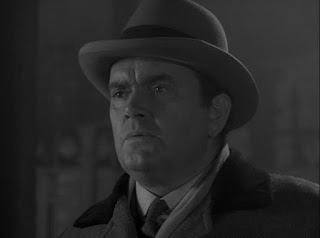
Theodore Bikel as Sergeant Ottermole
Comparing the existing versions of "The Hands of Mr. Ottermole" to Burke's story is interesting and allows one to determine with some accuracy what Francis Cockrell contributed to the evolution of the story when he later adapted it for Alfred Hitchcock Presents. Each of the four existing versions of the story (three on radio and one on television) preserves the essential structure of Burke's story while making certain changes. The 1946 radio version is set in London in 1890, near the end of Britain's Victorian era, and a narrator describes the events leading up to and including the Whybrow murder in a long opening sequence. Perhaps thinking that the murder of a child was too shocking for 1946 radio listeners, the second murder victim becomes an adult woman, while the third remains a policeman. In a major change to Burke's story, the character of the reporter becomes much more central and is introduced early in the proceedings. He appears after each murder and eventually becomes a suspect due to his proximity to each crime. In the final confrontation, the reporter has a gun and shoots Ottermole as the policeman strangles the reporter. Ironically, both men die, and the mayor later awards a posthumous medal to Sergeant Ottermole for killing the reporter, who is thought to have been the strangler! This version of the story was written by L.K. Hoffman.

Two and a half years later, "The Hands of Mr. Ottermole" was again adapted for radio, this time for Suspense, where it was broadcast on December 2, 1948. The script was by Ken Crossen and the story is narrated by Sergeant Ottermole himself, played by Claude Rains, whose marvelous voice is used to great effect as he tells the story to the reporter, played by Vincent Price. This time, the murder of Whybrow is followed by the murder of the policeman, skipping the girl's murder altogether. Having Ottermole narrate the story makes it even more shocking when he is revealed as the killer and, as in the story and the 1946 radio version, the sergeant succeeds in killing the reporter. This time, however, the reporter had sent a letter to the newspaper identifying the killer and Sergeant Ottermole is later sentenced to death and hanged. The Suspense adaptation of Burke's story is widely available and may be heard here.
Rhys Williams as Summers, the reporter
The third and final radio adaptation of the story was aired on May 2, 1949, just five months later, on NBC's Radio City Playhouse. This time, the setting was moved from London to New York City, where the borough of Brooklyn is terrorized by the Greenpoint Strangler. This version is the only one to feature the murder of the little girl, as in the original short story, and once again the reporter has a gun and shoots Sergeant Ottermole, killing the strangler but surviving the encounter. Ironically, a $10,000 reward is posted for the killer of the sergeant, so the reporter cannot write the story and admit killing the murderer. Instead, he writes a false story and claims that Ottermole was the strangler's next victim. George Lefferts wrote the script for this version, which may be heard here.

In addition to being the subject of four radio adaptations in the years from 1945 to 1949, "The Hands of Mr. Ottermole" was also the subject of some critical acclaim in the immediate post-war years. Ellery Queen included it in the 1946 collection, 101 Years' Entertainment: The Great Detective Stories 1841-1941, and it was selected by Anthony Boucher for inclusion in the 1947 volume, Murder By Experts. In both books, it was referred to as one of the all-time great mystery stories.

Less than two months after the story was adapted for Radio City Playhouse, it made its TV debut on Suspense, in an adaptation credited to Frank Gabrielson and directed by Robert Stevens. This version was aired live on June 28, 1949, and has been lost. The story was aired live for a second time on Suspense on November 28, 1950; this version is also lost and the writer of the teleplay is unknown, so it is not clear if the 1949 script was re-used. This version starred Robert Emhardt, who would later appear on six episodes of Alfred Hitchcock Presents.

Summers and Ottermole in the London fog
The last adaptation of "The Hands of Mr. Ottermole" was filmed for Alfred Hitchcock Presents and has become the definitive version due to its availability and the quality of the production. The teleplay is by Francis Cockrell and the show is directed by Robert Stevens, who also directed the two prior television adaptations for Suspense. The time and place are set by means of a title superimposed on the opening establishing shot; "London 1919," the title reads, and behind it is a foggy scene of the Thames with Big Ben in the background. There is a dissolve to an "Underground" sign and the mobile camera then follows Mr. Whybrow through the foggy East End streets.

Cockrell's first notable addition to the story is the killer's habit of whistling "Greensleeves" just before each murder; the old English tune is haunting and tips the viewer off to imminent danger. Whybrow's walk home and subsequent murder are depicted as in the story and in prior adaptations; director Stevens uses his camera to show the scene from the killer's point of view, as he follows Whybrow home and strangles him when the man opens his front door.

Cockrell introduces a new character in Whybrow's nephew, who is summoned to the house of the murdered couple and questioned. Sergeant Ottermole is in charge of the investigation; Theodore Bikel plays the character with a Scottish accent, marking him as the "other" even amidst his fellow policemen. In the scenes that follow, Cockrell's script follows the prior radio adaptations by bringing the reporter into the story as a character much earlier and having him pester Sergeant Ottermole about the lack of progress in the police investigation.

Stevens stages the second murder evocatively; Cockrell eschews the death of a child and instead has the killer strangle an old woman selling flowers. We know a murder is coming because we hear Ottermole whistling "Greensleeves" again and we see the use of the subjective camera that both provides the killer's point of view and masks his identity. As the flower lady is being strangled, the camera pans up and over to a store window beside her and the word "Palmistry" is written in large letters on the window. Inside the window display, a large model of a hand rotates, reminding the viewer of the hand motif that runs throughout the story.

Cockrell uses dialogue in the scenes that follow to delve into the killer's motive or lack thereof, as the reporter visits the police station and converses with Ottermole and a police constable. The constable suggests that the killer is a foreigner and, while he surely means a Chinaman--London's East End was filled with immigrants from the Far East at that time--the actual killer is a Scotsman, a foreigner who is able to blend in among the British. On another foggy night, the same constable discovers the dead body of a policeman and then the reporter, here named Summers, figures out the identity of the killer and makes the fateful decision to approach Sergeant Ottermole on a foggy night street.

The one constant with all of the adaptations of "The Hands of Mr. Ottermole" is the writers' determination to tinker with the ending. In the version filmed for Alfred Hitchcock Presents, Summers confronts Ottermole and the sergeant begins to strangle the reporter, but this time the constable grabs Ottermole from behind and subdues him before he can kill the reporter. Ottermole is handcuffed and led away and Summers is troubled by the sergeant's comments about ideas coming into his hands. The show ends here, with both Ottermole and the reporter surviving the final conflict and without any confusion about the killer's identity.

Torin Thatcher as Constable Johnson
Francis Cockrell's script for "The Hands of Mr. Ottermole" differs from those used for radio adaptations in that it relies heavily on dialogue rather than narration to advance the story. He inserts the flower lady in early scenes so the viewer is familiar with her by the time she is killed, and he gives the killer the habit of whistling "Greensleeves" before each murder. Robert Stevens does an outstanding job of direction, creating a foggy London atmosphere that fits the mood of the story perfectly and using subjective camera work to hide the murderer's identity and force the viewer to identify with him by showing the first two killings from his point of view. In short, this episode is a classic example of what the Hitchcock show does best: creating suspense and entertaining the viewer, even when telling a familiar story.

Robert Stevens (1920-1989) worked mostly as a TV director from 1948 to 1987, directing 105 episodes of Suspense from 1949 to 1952 and 49 episodes of the Hitchcock show. He won an Emmy for "The Glass Eye."

Thomas Burke (1886-1945), who wrote the story, was born in London and wrote both novels and short stories, often set in the Limehouse District of London's East End. Three of his stories were adapted for Alfred Hitchcock Presents, including "John Brown's Body."

A.E. Gould-Porter as Whybrow
Sergeant Ottermole is played by Theodore Bikel (1924-2015), who was born in Austria and whose family fled to Palestine in 1938. He began acting on stage in his teens, moved to London in 1945, and finally settled in the U.S. in 1954. He was on screen from 1947 to 2003 and also had a busy career as a folk singer and musician. This was his only appearance on the Hitchcock show, though he also played a memorable role on one episode of The Twilight Zone titled "Four O'Clock."

In the role of Summers, the reporter, is Rhys Williams (1897-1969), an actor who was born in Wales and who made his screen debut in John Ford's How Green Was My Valley (1941). He was on screen until 1970 but this was his only appearance on the Hitchcock show.

The police constable who prevents Ottermole from killing Summers is played by the familiar character actor Torin Thatcher (1905-1981), who was born in India to British parents and who was on screen from 1927 to 1976. In addition to three appearances on the Hitchcock show (including "Bed of Roses"), he was seen on Thriller and Night Gallery and played important parts in Great Expectations (1946) and The 7th Voyage of Sinbad (1958).

Charles Davis
A second reporter is played by Charles Davis (1925-2009), who was born in Ireland and who worked mostly on TV from 1951 to 1987. He was seen on seven episodes of Alfred Hitchcock Presents, including "I Killed the Count," where he plays the long-suffering junior to John Williams's inspector.

In small roles, A.E. Gould-Porter (1905-1987) plays the ill-fated Mr. Whybrow; he was in 10 episodes of Alfred Hitchcock Presents, including "The Glass Eye." His wife, who is heard but not seen, is played by Hilda Plowright (1890-1973), who was also in "Banquo's Chair" as the ghost.

"The Hands of Mr. Ottermole" is available on DVD here or may be viewed online here.

Sources:
Athanason, Arthur Nicholas. “Thomas Burke.” Twentieth Century Crime and Mystery Writers, Springer, 2015, pp. 227–230, books.google.com/books?id=_U6vCwAAQBAJ&dq=thomas+burke+in+twentieth+century+crime+and+mystery+writers&source=gbs_navlinks_s.
Burke, Thomas. “The Hands of Mr. Ottermole.” 65 Great Murder Mysteries, edited by Mary Danby, Octopus, 1983, pp. 91–105.
The FictionMags Index, 29 Dec. 2017, www.philsp.com/homeville/FMI/0start.htm.
Grams, Martin, and Patrik Wikstrom. The Alfred Hitchcock Presents Companion. OTR Pub., 2001.
“The Hands of Mr. Ottermole.” Alfred Hitchcock Presents, season 2, episode 32, CBS, 5 May 1957.
“The Hands of Mr. Ottermole.” Molle Mystery Theatre, 21 June 1946.
“The Hands of Mr. Ottermole.” Radio City Playhouse, 2 May 1949.
“The Hands of Mr. Ottermole.” Suspense, 2 Dec. 1948.
IMDb, IMDb.com, 29 Dec. 2017, www.imdb.com.
Nyhagen, Dennis. “Molle' Mystery Theatre [Mystery Theatre] Radio Programs.” The Definitive Molle Mystery Theatre Radio Logs with Geoffrey Barnes, Bernard Lenrow, and Dan Seymour, 30 Dec. 2017, www.digitaldeliftp.com/DigitalDeliToo/dd2jb-Molle-Mystery-Theatre.html.
Stephensen-Payne, Phil. “Galactic Central.” Galactic Central, philsp.com.
Wikipedia, Wikimedia Foundation, 29 Dec. 2017, www.wikipedia.org.

In two weeks: "The West Warlock Time Capsule," starring Henry Jones!

Journey Into Strange Tales! Atlas/ Marvel Horror! Issue 23

The Marvel/Atlas  Horror Comics Part Eight June 1951 Strange Tales #1 "The Strange Men"  (a: Paul Reinman)  ★  "The Beast...