Showing posts with label Shock SuspenStories. Show all posts

EC Comics! It's An Entertaining Comic! Issue 56


The EC Reign Month by Month 1950-1956
   56: January 1955, Part II


Kamen
Crime SuspenStories #26

"The Fixer" ★★
Story by Carl Wessler
Art by Jack Kamen

"Dead Center" ★★
Story by Jack Oleck (?)
Art by Joe Orlando

"The Firebug" ★★ 1/2
Story Jack Oleck (?)
Art by Reed Crandall

"Comeback" ★★ 1/2
Story by Carl Wessler
Art by Jack Kamen

When the homicide detectives find young Billy standing alone in his family's kitchen and the bodies of his dead parents on the floor, they sit the lad down and ask him what happened. Billy tells them that, ever since his family moved into the neighborhood, they were shunned by the neighbors for being poor. The cruel treatment drove his Dad to drink and when neighbors started being murdered in the night, people started to suspect Billy's Pop of doing more than boozing. Finally, Billy's Mom accused her husband of the killings, showing him a bloody knife she found in a kitchen drawer. A struggle ensued and she was stabbed to death. Dad then took his own life with a pair of scissors. Billy explains to the cops that it was unnecessary, since he had been playing the role of "The Fixer" and knocking off the mean people who made his parents sad.

Jack Kamen stages a death in "The Fixer."
I knew it was Billy from the very first panel! Wessler and Kamen present a story that is at once obvious and confusing. Was there not a single decent person in the neighborhood? Why could Billy's family only find one house to rent, and why was it out of their price range? How did Billy manage to sneak out at night and murder a series of adult neighbors? My most pressing question is, what did Jack Kamen do before and after EC? According to Wikipedia, he went into advertising and one of his sons invented the Segway. Who knew?

Arthur's wife Selma loves professional wrestling, but Arthur hates it, so their best friend Milty starts taking Selma to the St. Mark's Arena in New York every week to see the matches live and in person. Arthur buys a TV set so Selma can watch the matches at home but she prefers the smells and sounds of the live event. Arthur grows consumed with jealousy, convinced that Selma and Milty are doing some wrestling of their own. He buys two tickets for them, "Dead Center" in the front row, so he can watch the match on TV and see them sitting next to the ring in order to prove that they're not off in a motel somewhere. The match airs, he looks, and the seats are empty. When Milty and Selma get home, he shoots them both dead, only to hear the TV host announce that, this week, they televised the match from Chicago, not New York.

Two things to love about "Dead Center."
Arthur is such a dope. Why not follow Milty and Selma and shoot them at the motel or hire a private eye to do it like everyone else? No, he has to cook up this cockamamie scheme involving buying front row tickets and watching the match on TV. Even then, he doesn't hear the announcer say that the match is happening in the Windy City, which surely must have been mentioned about a hundred times. You're telling me the arena looks exactly like the one in NYC? What a dolt. Joe Orlando's status as one of the lesser EC artists is growing, since his work on this story is not impressive at all.

Fire chief Mitchell Slade leads his team in battling a warehouse blaze. Was it started by an arsonist, a pyromaniac? If so, then who is "The Firebug"? That's the question that bothers Lieutenant Humphries of the Arson Squad. Humphries finds proof of arson and the arsonist sets a plan in motion. Humphries gets a late-night call from Slade, who was warned about another fire. Slade gets to the scene first and beats the supposed arsonist to death before Humphries can stop him. Later, when the two men share a drink at a bar, Slade lights a match for Humphries's cigarette and Slade's reaction to the flame is so extreme that it becomes clear he is the real arsonist.
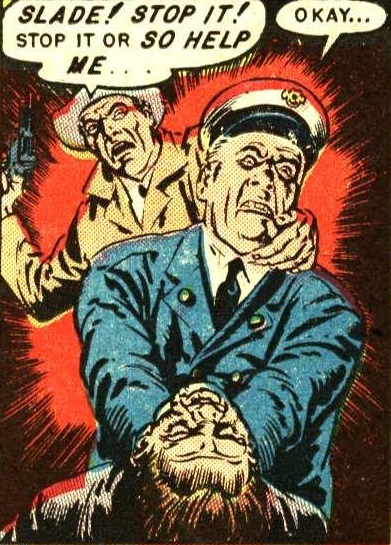
"Okay, I'll stop now."
("The Firebug")
Reed Crandall's art is impressive, so much so that it distracted me from the weaknesses in this five-page story. As in the Kamen story that opened this issue, I knew who the culprit was from the start, and the twists and turns of the plot came too quickly to make much sense. What really bothered me was Slade murdering the man right in front of Humphries with Humphries barely batting an eyelash. I don't buy it for a minute.

Sybil Oliver is not fooled at all when hubby Raymond comes home and shows her the neat new letter opener his friends at work gave him for his birthday. She is well aware that it was a gift from Joyce Adams, the cashier with whom he's been having an affair. Raymond thinks back to how it all began and, after we wake up from a three-page flashback about Raymond and Joyce's courtship, he demands that Sybil grant him a divorce. She says no, and he kills her with the letter opener. Like any good wife killer, he goes to work the next day, steals fifteen grand from the bank safe, and hot foots it to South America, where he disappears into the fields and lives as a peasant for months. Finally missing Joyce too much to go on, he shaves and cuts his hair, returns to the big city, and looks her up, only to find his "Comeback" ruined by the news that Joyce was electrocuted for the murder of Sybil over six months before. Her fingerprints were all over the letter opener, see, and he was wearing gloves at the time of the murder . . .

Jack Kamen stages another death.
("Comeback")

At least one story in this issue had a twist ending that I did not see coming. The plot is decent and makes the cookie cutter artwork by Kamen bearable. But why two Kamen stories in the same issue?  --Jack

Peter: The penultimate number of Crime SuspenStories is one of the worst single EC issues I've had to sit through, with only the Reed Crandall art as a minor plus (even Crandall seems to phone it in for the most part). The "shocks" are telegraphed or, in the case of "Comeback" and "The Firebug," never materialize. "The Fixer" and "The Firebug" read like rejects from Shock, with their "deep analysis of the human condition," but lacking the real depth found in those early Shocks. Two of the stories are uncredited but there's no reason not to believe they were penned by the same writer responsible for the other two atrocities. This is a really long fall from the heights of the previous year. Two Kamens. Did you think I'd be happy?

Peter has second thoughts after passing up a rare paperback.
("The Firebug")


MAD #19

"Mickey Rodent!" ★★★★
Story by Harvey Kurtzman
Art by Will Elder

"Supermarkets!" ★★ 1/2
Story by Harvey Kurtzman
Art by Jack Davis

"Puzzle Pages!" ★★★ 1/2
Story by Harvey Kurtzman
Art by Will Elder

"The Cane Mutiny!" ★ 1/2
Story by Harvey Kurtzman
Art by Wally Wood

"Mickey Rodent!"

"Mickey Rodent!"
Why the heck is "Mickey Rodent!" trying to contact Darnold Duck? Everyone in town, from sexy Minny Rodent to Pluted Pup (the only mute animal in Walt Dizzy's world) to Goony, has been stopping Darnold in his tracks and relaying the message: "Mickey Rodent is looking for you!" The Duck can't stand the Rodent as the dirty rat can't help but hog the spotlight and, anyways, who's the bigger star in the Dizzy universe? The rat or the fowl? So, whatever, the rat finds the duck and the duo scamper off, trading insights on life in the Dizzy world (why do all the animals have to wear white gloves? Even on hot days.) and eventually doffing clothing and skinny-dipping in a local mud hole. While the boys (?) are enjoying freedom, some miscreants (probably the Looney Tunes) swipe their garments, thereby leaving them open to the elements. Our heroes follow the tracks of the robbers to a nearby zoo but, in a moment of evil selfishness, Mickey locks Darnold in a cage and hightails it, ostensibly to renegotiate his contract with Walt Dizzy.

"Mickey Rodent!"

Though not quite reaching the lofty heights of "Starchie!" (which was, despite what my two knucklehead colleagues might say, the Best Story of 1954), "Mickey Rodent!" comes pretty darned close. Is it just that I love these strips that demolish beloved icons, showing us how these characters would look and behave in "the real world," or is it that Harvey has a special gift for crawling under their shiny surfaces and pointing out the absurdities we ignore? Maybe both. Particularly hilarious is the scene of Mickey and Darnold, foliage covering their naughty bits, walking through the forest when the Duck notices Bill Elder's signature at the bottom of the page and exclaims, "Hah, look at that signature! It's not Walt Dizzy's style . . . I knew the style of this drawing was different!" Or how about Goony advising Darnold that maybe he should wear pants the next time he leaves the house? Blink and you'll miss KurtzElder's subtle slam at the Disney merchandising machine in the guise of Big Ben with a Mickey face.

"Supermarkets!"

The last we saw of Dad Sturdley and his family, they were braving the wilds of a "Restaurant!" (back in #16). Not having learned their lesson, the Sturdleys decide that it's a good time to investigate that new supermarket down the road. Bad parking, frenzied automatic entrance doors, unobliging and obese fellow shoppers, and grocery carts designed for the Indy 500 are just some of the obstacles in the way of the Sturdleys' happy adventure. In the end, our hapless family agrees that maybe that little Ma and Pa shop they frequent is adequate. "Supermarkets!" is mildly amusing in the same fashion as that earlier Sturdleys chapter (by the way, Jack Davis's Sturdleys look nothing like the earlier version conjured up by Will Elder), but it's apparent to me that MAD's bread and butter is its media parodies rather than its piercing eye on the American way of life; that will change within a couple years, of course.

Relax with an easy brain twister!
("Puzzle Pages!")

What's more relaxing with your cup of coffee in the morning or after a long day in the salt mines? Why, a brain puzzler, of course! And the editors of MAD have been generous enough to share with us several difficult brain teasers. In fact, some are downright impossible. These types of parodies are usually pretty bad but I stopped counting guffaws at about 100 (Rebus #4 is especially side-splitting-- it's reprinted below); there are just so many clever little nuances to KurtzElder.

And they've been nice enough to provide the solutions!
("Puzzle Pages!")

"The Cane Mutiny!"
The USS Cane has gone to pot thanks to its slob of a captain, but now the Navy intends to put things right by sending out a slave driving captain named Kweeg. The men (including Ensign Willie Wontie) immediately take offense to everything the new guy does, including subjecting them to eating desserts of white sand (don't ask) and wearing pants. Eventually, matters reach a boiling point and the crew mutinies. A court case (shown "off screen" because it would be to boring for readers) ensues and Wontie is assigned another ship: the Bounty. "The Cane Mutiny" is the only real dog this issue but it's quite a dog, lacking anything resembling humor. Instead, Harvey resorts to renaming characters and dragging "laughs" out across several panels. It's all rendered by Wally, which is a plus, but it's a real slag to get through.
--Melvin Enfantino

Jack:  I'm surprised EC did not get sued by Disney over "Mickey Rodent!" I thought it was reasonably amusing until the last page, which I thought was great. Overall, it's pretty biting satire. "Supermarkets!" was also somewhat funny, though a bit long at eight pages. Not much has changed about grocery stories since the '50s, except that neat conveyor belt that sends your groceries outside where a clerk loads them into your car for you. "Puzzle Pages!" was funny, especially the answer page, and "The Cane Mutiny!" is another dud of a movie parody, livened up only by Wood's insertion of a gorgeous gal every so often.

Proof that the readers may have been just
as MAD as the creators.


Craig
The Vault of Horror #40

"Old Man Mose!" ★★ 1/2
Story and Art by Johnny Craig

"An Harrow Escape!" ★★
Story by Carl Wessler
Art by Joe Orlando

"The Pit!" ★★ 1/2
Story by Carl Wessler
Art by Bernard Krigstein

"Ashes to Ashes!" ★★ 1/2
Story by Carl Wessler
Art by Graham Ingels

Ned Rogers comes upon some boys throwing stones at "Old Man Mose!" and stops them, protecting the unfortunate man and hiring him to help around the house. Not used to being treated kindly, Mose grows attached to Ned and his wife Belle. Soon, the townsfolk warn Ned about Mose, who is said to consort with the Devil. Ned sticks up for Mose and heads home, where he finds that the stock on his rifle has split and he needs a replacement. After having trouble sleeping that night, Ned awakens and encounters Mose coming home late, claiming he was out for a walk. The next day, the townsfolk tell Ned that a man was murdered the night before. He lies and says Mose was with him all night. Ned races home, worried that Mose is a killer and that Belle is in danger. He arrives home to find Belle on the kitchen floor and Mose with scratches on his face. He beats Mose to a pulp before his wife reveals that the old man was protecting her from a murderous escaped convict, whose dead body lies just outside, near where Mose had spent the previous night making a new rifle stock for Ned.

"Old Man Mose!"
I was surprised to see in the GCD that Johnny Craig wrote this story, since it has the same clunky plotting we've come to expect from Carl Wessler. Things are going along fairly smoothly until there's that obvious plot device of the broken rifle stock, which stands out and is clearly a setup for something to come later. Craig's art is still fine, but the writing is not what it was earlier in the series.

Captain Grady brings his Coast Guard cutter alongside the Seawitch, a small craft drifting aimlessly on the waves, and boards her, only to find a dead woman on one bunk and a nearly dead man on another. The man tells a strange story: he and his fiance, along with another couple, were on a cruise the day before when their boat was caught in a storm and they sought refuge at a castle on Harrow Island. That night, the man discovered that their hosts were vampires and that the other couple was dead. He killed one vampire but was too late to save his fiance, who had been bitten already. The captain thinks the story of "An Harrow Escape!" is bunk but, just to be sure, his lieutenant plunges a stake into the woman's heart and her body turns to dust. Not long after that, the captain and his lieutenant are up on deck and realize--too late--that if the woman was a vampire and bit the man, he must be a vampire, too. As he attacks them from behind they realize they were right.

Surprise! He's a vampire!
("An Harrow Escape!")
Carl Wessler's stories tend to follow the same pattern: he introduces a strange scene, then has a long flashback to explain how things got that way, then brings us back to the present, where the conclusion soon occurs with a supposedly surprising twist ending. This story is a straightforward vampire tale with little new or different from many we've seen before. Orlando's art is less offensive than it has been in some time, however, and he draws the young woman well.

The crowd revels in bloodshed as two roosters fight to the death in "The Pit!" Felix Johnson doesn't much like running the violent show but his wife Lila likes the money it brings in. They have competition from Aaron Scott and his wife Beatrice, who run a nearby dog fighting show in a similar pit. Things go from bad to worse as the wives badger their husbands to make the games bloodier and more violent to try to attract crowds away from each other. In the end, the husbands put their wives in the pit for a final, bloody battle.

Yikes!
("The Pit")
Bernie Krigstein sure draws some weird-looking people! There are panels in this story where the spittle in the characters' mouths resembles long fangs. The story is fairly obvious and disgusting, but I must be a dope because I did not see the ending coming until the last page. That final panel is pretty gruesome, with Lila sinking her teeth into Bea's arm.

For six generations, the male members of the Frankenstein family have worked to create life. At age 50, Emil Frankenstein finally succeeds! A seemingly perfect baby is born from raw slime, but is it normal? Can it grow and reproduce? To test it, Dr. Frankenstein switches the baby at a hospital for a dead infant and then watches it grow up for twenty years, at which point the good doctor observes two young men, Karl and Heinrich, arguing over a woman named Louisa. She chooses Heinrich and Emil comes back later with a gun but, instead of shooting his rival, he accidentally kills Louisa. Her body dissolves into "a greenish-black blob of vile, stinking decay," demonstrating that she, and not one of the two men, was the Frankenstein baby grown to adulthood.

Fifty?
("Ashes to Ashes!")
Like Joe Orlando, Ghastly brings his "A" game to "Ashes to Ashes!," a story that appears late in the day for the EC horror line. Wessler's story is nothing special, and the twist ending isn't very exciting, but Ingels does very smooth work.--Jack

Peter: The final issue of Vault is, for the most part, a well-written parting shot. "The Pit!" should be the obvious standout here, with its B. Krigstein art and "deep, meaningful" script. Krigstein gets high marks as always but Wessler's script is predictable and, ultimately, pretty silly. My compadre, Jack, may slight BK for the exaggerated and downright disturbing Bea and Lila but I'd argue that was the point. Without the escalated transformation from sexy babe to bloodthirsty beast, this would just be another weak Shock wannabe. Imagine "The Pit!" with Kamen attached!  I liked "Old Man Mose!" as well, especially the fact that we never see the real threat until the final panel and no tidy expository (other than a mention that the assailant is an escaped con). Craig avoids all the usual cliches and just tells an interesting story. "Ashes to Ashes!" is a bit talky but it's a clever reworking of the Frankenstein mythology and benefits from one of the best last lines in an EC horror story.  "An Harrow Escape!" is the only dud this issue, a juvenile monster story with a twist ending that was, evidently, only surprising to its writer. "Oh, crap, he's a vampire? Who'da guesst?" Interesting that Johnny Craig was assigned to redraw one of "Harrow" panels for the cover.


Evans
Shock SuspenStories #18

"Cadillac Fever!" ★★ 1/2
Story by Carl Wessler
Art by George Evans

"The Trap" ★ 1/2
Story by Carl Wessler
Art by Jack Kamen

"In the Bag" ★★★★
Story by Carl Wessler
Art by Bernard Krigstein

"Rundown" ★★ 1/2
Story by Carl Wessler
Art by Reed Crandall


"Cadillac Fever!"
Poor Clyde Wilkes jes' wants ta ride in a Cadillac once afore he dies but his greedy wife, Effy, steals his saved-up quarters for more of her consarned women stuff. What's a man to do? Effy pays no heed to Clyde's threats of blowin' a hole in her mid-section and the thievery continues. Daughter Ruthie sympathizes with her hen-pecked pa but what's a poor young girl to do aside from escortin' Clyde past the Cadillac dealership every day and feedin' his dreams of someday ridin' in a Caddy? Then, one day, Effy turns up with a "hole in her big as youah fist" and the law comes down on Clyde. At the trial, Ruthie allows as how Pa gunned down her Ma after a steamy altercation and Clyde is sentenced to die in the 'lectrical chair. Once Clyde gets his Caddy ride, in a coffin to the cemetery, Ruthie owns up to pullin' the big trigger on her Ma so's Pa could satisfy his "Cadillac Fever!" Carl Wessler satisfies his need to be Erskine Caldwell for six pages and we're left with an okay SuspenStory (well, I could have done without the silly final expository) and some nice Evans visuals. Ruthie's scene with Mr. Wyler, a wealthy Caddy owner, is nicely handled and genuine pathos is generated from Clyde's predicament, but we've seen Effy, a cliche if there ever was one, several times before.

Yep, pre-murder Matt looks
completely different from post-
thanks to the wonder of Jack Kamen.
("The Trap")
Nag nag nag. That's all Irene Hall can do as far as hubby Matt is concerned. She's not happy with the dump they live in or the rotten neighborhood they're stuck in or the rags she wears, but there is a way out, she insists. If Matt could cash in his life insurance policy, they could have twenty grand to splurge on the niceties of life. Irene has even enlisted the help of local undertaker (and, evidently, medical examiner) Larry Grover and the two have concocted the perfect plan: Matt will fake his own death and Grover will take care of all the "burial" arrangements. Matt bites and the plan is put into action. After Matt is declared dead, he heads for Argentina to lay low for a year, at which time his wife will join him. Eighteen months later, with no sign of Irene, Matt gets fidgety and heads back home, only to find Irene and Grover married. When Matt raises a fuss, the couple ID him as the killer and he hangs for his own murder! Interminably simplistic (Grover manages to oversee everything related to the "Matt Hall murder case" and the police, evidently, never lay their eyes on the "corpse"), head-scratchingly baffling (Matt grows a mustache in order to fool the entire town into thinking he's someone else--in a Kamen cartoon!), and just plain giggle-inducing (when a cop is asked to check post-murder Matt's fingerprints, he exclaims "That's it, chief! I thought they looked familiar . . ." and whips out the fingerprints from the murder weapon--a perfect match!), "The Trap" is a blending of several elements we've seen countless times before, usually wrapped in a Kamen bow: the shrewish wife, the hen-pecked hubby, the faked death, and the more-than-a-little-interested third party. Special Award for Stupidest Husband of 1955 goes to Matt Hall.

The world's most observant beat cop.
("The Trap")

"In the Bag"
McLeod, a plain-clothes cop, becomes suspicious when a mousy guy with an odd sack shuffles by. When McLeod shouts to the man to halt, he notices the bag is round with a red stain at the bottom. The creep hightails it but McLeod manages to catch up. When pressed, the man admits that, "In the Bag" lies the head of his pushy boss. The psycho gets away and McLeod alerts two beat cops to issue an APB while he searches the dark streets. Hearing footsteps behind him, McLeod turns to see a man approaching, holding a sack, and the cop guns him down. The beat cops return, informing McLeod that they've apprehended the psycho with the bloody bag. McLeod has shot a man carrying a bowling ball.

I've run out of adjectives for the work of Bernie Krigstein so I'll just drop my jaw and utter, "Wow!" I thought I'd be clever and highlight some of the genuinely unique aspects of "In the Bag" but, alas, it's already been done by EC historian extraordinaire, Bhob Stewart, in an interview that appeared in Squa Tront #6 (1975):

"In the Bag"

Bhob Stewart: We were sure you had adapted film technique to comics when we found a panel in "In the Bag" where you had drawn the effect of the headlights of a car reflecting on a camera lens.

Bernie Krigstein: That's definitely an occasion where it was a camera effect . . . Sometimes I'd think in terms of a camera or a movie . . . I desired to stop all action and make everything still and repetitious, and come back again and again, and keep repeating the effect. I'm fascinated by movies.

And you can tell just by turning the pages and drinking in Krigstein's panels. So many are almost like the flickering of film frames, such as the sequence on page three (below), where the murderer is relating his motive to McLeod and his face changes shape and reaction each successive panel. The aforementioned headlight reflection from the first page and McLeod's flashback of a previous series of murders (shown only in black, white, and blue and as if seen through McLeod's eyes) contribute to that vibe that we're actually watching the events unfold on the big screen down at the Fox on Friday night. The beat cop's hushed "You . . . you better give me your gun, McLeod" accompanies our "Holy Crap!!!" as the screen fades.

Best Story of the Year is
almost "In the Bag."

"Rundown"
All that Joe Harris needs, he believes, to keep his gorgeous wife, Marsha, from running away with another man, is a little dough. So the dope withdraws all forty-three bucks from his account and lets it ride on red. When the little ball lands on black and Joe is broke, he hangs around at the casino to watch an elderly man clean up. The man makes a haul of over sixty grand and then heads for home, with Joe following. A simple robbery goes bad and Joe ends up gutting the man, but the real problem is getting rid of the evidence. Our hapless "hero" can't find an unpopulated area anywhere in the city, finally having to do with stuffing the body down a manhole. Fearing he's been seen by a couple of cops, Joe hightails it, only to discover one of the officers hot in pursuit. Crossing the street in a panic, Harris is "Rundown" and fatally wounded by an auto driven by--surprise!--his wife and her lover. The cop helpfully explains to Marsha that she can come down and claim Joe's bankroll at the precinct as her husband expires. "Rundown" is not a great script but it's not awful; it's a quick five-minute read and has a couple of nice twists in its final panels, and who can complain when the visuals are supplied by Reed Crandall? Marsha is cut from that same broad cloth that Carl drew from to create Effy Wilkes and Irene Hall, three shrews with not a whit of personality or originality between them. The same could be said for weak-kneed and hen-pecked Clyde, Matt, and Joe. Not a strong man among them.

"Rundown"

When we began this journey two years ago, I had not read any of the EC stories in over thirty years (since the Cochran box sets were published) and, to my mind, the strongest title was Shock. The twists, the controversies, the tackling of subjects ignored by other publishers, this series had it all. So, how did it measure up on re-reading? Not as perfect as I recall but still pretty damn good. Of the 72 stories Shock presented, I awarded 32 with a rating of three stars or more (ten of those got a perfect "four"). That's a respectable percentage if stacked up against the other titles (and I'll present a complete overview in our publisher wrap-up in December) and it's even more respectable if you omit Jack Kamen's sub-par contributions. So many classic Shockers. This is one title I am very much going to miss. --Peter

Jack: Not surprisingly, my ratings for the stories were exactly the same as yours, except for "In the Bag," since I'm not as gaga over Krigstein as you are. The issue as a whole is dragged down by Carl Wessler's mediocre writing. The cornpone dialog in "Cadillac Fever!" is a chore to read and the final ride is obvious from early on, but Evans's art is a joy. Not so Kamen's work in "The Trap," where some panels are so bad I wonder if Kamen even drew them. The story is terrible, too--bottom of the barrel. "In the Bag" gets almost all of its noir atmosphere from Krigstein's art, but the story doesn't come close to a four-star rating. Finally, Crandall shines in "Rundown," making me think he and Evans are my favorites at this point. Two Cadillac stories in the same issue is at least one too many and the ending comes out of left field. That panel of Joe getting run over is a shocker.


Next Week in
Star Spangled DC War Stories #129:
Is This the End of Easy?

EC Comics! It's An Entertaining Comic! Issue 53


The EC Reign Month by Month 1950-1956
  53: November 1954 Part II


Evans
Shock SuspenStories #17

"4-Sided Triangle" ★ 1/2
Story by Carl Wessler
Art by Jack Kamen

"In Character" ★ 1/2
Story by Al Feldstein
Art by Reed Crandall

"The Assassin" 
Story by Carl Wessler
Art by George Evans

"The Operation" 
Story by Al Feldstein
Art by Joe Orlando

Old Farmer Abner has taken a shine to how well his “half-witted” housekeeper Annie has developed into a young woman, but Abner’s crotchety wife Hester always pops in at the most inopportune moments to dampen his flames of passion. Besides, as Annie explains to both of them, she has a boyfriend that she sees on the regular, which burns Abner up in whole 'nother way. But he soon discovers upon following Annie out of the house on one of her nocturnal trysts that her “boyfriend” is none other than the scarecrow overlooking the wheat fields. Reasoning with Annie does nothing to break her from her fixation; she tells Abner that she is convinced the straw-man is alive and will one fateful day prove his love to her. With libido raging like a mighty river, Abner decides to take matters (and more besides) into his own hands when he hunts Annie down again in the fields one night. Back at the farm Hester smells adultery and storms out with pitchfork in hand. She finds Annie lying next to her boyfriend, spent from a glorious moment of passion. Just to prove to the girl her romance is an illusion, Hester takes the pitchfork to the straw-man, unknowingly impaling her husband in disguise.

A "hot and heavy" kiss as depicted
by Jack Kamen.
("4-Sided Triangle")
There’s no question that following the Congressional hearings that Bill Gaines attended in 1954 that his publishing house essentially adopted a “screw it, we’re sunk anyway” attitude toward the New Trend content that remained for that year. Over the last few issues we’ve reviewed we’ve not only seen gradually escalating levels of rampant cartoon violence (not enough for the poor sap in “Forever Ambergris” to devolve into a rotting mess, but he’s gotta get sliced in half to boot) but a surprising frankness towards sexuality. As Peter so aptly highlights below, Carl Wessler took the Puritan-by-comparison “spent” metaphors that Al Feldstein had previously used mainly in the SF yarns and turned them up to 11 with “4-Sided Triangle.” The entire emotional thrust (sorry) of the story is Abner’s unchecked lust for his nubile victim, and were it not for Jack Kamen’s starchy illustrations, this story could very well have delved into pornography under the lascivious pen of a more adventurous artist. Coital relations aside, “4-Sided Triangle” is easily one of Wessler’s best scripts and is made such by the perversity at the heart of its central conceit. We all know what generous lovers scarecrows can be.

Horror actor Bela Kardiff is being given an honorary dinner and award for his years of thespian service in Hollywood with all of his favorite people in attendance. There’s his agent Don, who wrangled Bela into his career-defining role as Frankenstein’s monster; Lawrence, the president of the film studio who told Bela to check his actorly ambitions at the door; Marcel, the makeup artist who designed a suitably horrible visage for Bela; George, the PR man who schemed to make the monster the star of the picture; and finally Sidney, the studio’s treasurer who watched all the money from the movie pour in. They’re all very “good friends” of Bela; Bela the horror star who was eventually left penniless and begging for jobs and being scolded by mothers of frightened children. So tonight at this dinner Bela has decided to prove to the gang that despite his initial reservations, he’s warmed up to the idea of being the great horror villain everyone seems to think he is. You see, Bela has poisoned everyone’s glasses of celebratory champagne.

Jack and Peter assess Jose after
his first 4 months of fatherhood.
("In Character")
If it weren’t for the occasional and passably cute wink to the career of cinematic terror-king Boris Karloff (including a nod to his role as “editor” of some literary horror anthologies), “In Character” would be a complete waste of time. As it stands, it uses the biographical details of Karloff’s life—aside from the plague of being typecast as a monster, there really isn’t too much resemblance to the history of the character’s other namesake, Bela Lugosi—to tell a plodding story of revenge that you know precisely how it will end the minute Kardiff starts pouring the drinks. And I’m not sure what comic book Peter and Jack have been reading, but I don’t see “stunning” or “solid” work from Reed Crandall here by a long shot. Quit drinking that bubbly, fellas!

A rainy night, a loaded heater and a moving target exiting stage right from a ritzy hotel: “The Assassin” is on the hunt! The hired killer tracks his prey through the streets with the patience and perseverance of an old pro, but eventually the wary would-be victim gets the hint and tries giving his pursuer the slip through darkened alleys and bustling subway trains. But still the assassin follows on, even taking to the rooftops to snub out his prey with one well-aimed shot from his gun. Finally, the killer corners his target in a shadowy hovel and plugs him good. Suddenly, lights flash on and screams ring throughout the room. Turns out the assassin has performed the dirty deed onstage in front of 500 shocked theatre-goers.

I do *not* remember this number from Cats.
("The Assassin")
Plot-wise, there’s not much to encapsulate with “The Assassin,” which is fine with me because stories of its type are too rare here in the annals of ECdom. A real-time tale of a cat-and-mouse chase through gritty urban streets to a satisfyingly earned twist ending offers a kind of streamlined, no-frills approach to storytelling that we don’t see here too often what with subplots concerning So-and-So sleeping with XYZ Lover and plotting the murder of their spouse/neighbor/house pet, etc. Evans, as always, gets his noir groove on and frames a number of lovely panels, especially ones that show the assassin’s gloved hand looming in the foreground with his heater at the ready. Ka-pow!

“No honor among thieves” couldn’t be closer to the truth than in relation to the criminal ring made up of diamond mules Allie and Bimmy and their main man Doc Slater. The doc has concocted a particularly ingenious way of sneaking the precious gems past the customs offices that is full-proof: simply perform surgery on the mule and sew the goods inside them like a human purse. (“Rocks in His Head”, anyone?) Their scheme has gone beautifully for several thefts without a hitch, and when Doc Slater gets a lead on some wondrous 92-carat stones being housed at a local shop, Allie and Bimmy do their blasting stuff and snatch them up. To make things “fair” and ensure that the mule chosen to house the goods doesn’t split town, Doc puts both of his henchman under anesthesia and secretly operates on only one of them. But suspicion and greed gets the better of the two goons and they decide to settle their differences with a gentlemanly KNIFE MASSACRE. Doc Slater is a bit miffed at the carpet in his apartment getting so tarnished, but otherwise he’s happy as a clam since he in fact hid the jewels inside *himself* and had orchestrated his partners into cutting themselves out of the deal from the start. Too bad for Slater all the diamonds were phonies, and the residual paste from which they were made poisons the doc and kills him.

My upholstery! *Choke*
("The Operation")

I can’t remember which of my blogging compadres said it (that’s old age for ya), but at one point one of those geniuses made the assertion that bad art in a comic book could sink even the best script. I now submit Exhibit A: “The Operation,” very finely and wittily written by returning sensei Al Feldstein and nearly killed dead in the water by the leaden pencils of Joe Orlando. Orlando’s devolution from one of the company’s most exciting and interesting new artists to Rudy Palais on a bad day is utterly mystifying. What happened? Was Orlando gradually becoming less enthused over his work for EC due to the increasing social backlash the publisher was receiving in the wake of the Congressional hearings? Has what we’ve seen over the last few months been indicative of his desire to distance himself from Bill and Al’s New Trend? It’s been a while since I read my EC history books, but I vaguely recall some anecdotes regarding the shame Orlando’s family felt over his choice of employer. Or is this all just some hot air being expounded by an Internet know-nothing? I’ll leave all of that for the actual experts out there to hash out, but suffice to say “The Operation” could have easily been a much more remarkable story had it been drawn by the Joe Orlando that first showed up at the 225 Lafayette offices. --Jose

Peter: There's a sleaziness to "4-Sided Triangle" that won't be found in too many above-ground funny books; a middle finger to the Senate while the ship was sinking. The story itself is no great shakes--we've seen the horny older man lusting after the gorgeous and nubile young girl countless times just on this journey, never mind in all the other pre-code horror funny books--but it has enough moxie to it for me to classify this as one of the last greats of the New Trend years. It's not enough we witness feeble-minded Annie lusting for a scarecrow ("He can help me! He will! Someday! Someday . . .") but then we're voyeurs while the virgin gets her first taste of life's "little" pleasures (How long would this unwilling creature deprive her? How long this cruel neglect? How long? The answer came suddenly . . . startlingly . . . shockingly. No longer! Now! Now! This was her lover! How true her lover! How good her lover! The straw man . . . the stick and rag man . . . was hers at last!). Was there a more overtly sexual strip, even before the talons of the code? Of course, I've got problems with Jack Kamen's art, but Annie's so damn sexy it's hard to protest too much.

It's hard to see what Bela Kardiff is whining about so much; he's made lots of money off these monster flicks, but that's not enough? And, I get that he's bitter, but did he really have to dispatch the cinematographer, ferchrissakes? Seems a bit extreme. Even though the script may be a tad . . . oh, um, weak . . . at least we get some more stunning Reed Crandall work. "The Assassin" gives us a glimpse of what's to come when the New Trend exits stage left and the Picto-Fiction line begins. No dialogue save the requisite "Choke" and "Good Lord," and the prose is on the cliff looking into Purple Canyon, but the tale is an entertaining one and the twist is solid. Jack is on the money below when he mentions that this would be a good fit for Bernie Krigstein; it feels like a script tailored for BK. Finally, "The Operation" is filled with good and bad: the good being the very clever double-twist in its tail and the bad being the Sheldon Leonard-esque intelligent goon-speak that slows the pace down to a crawl and the really awful Orlando art. Joe was sticking out like a sore thumb among the class of Crandall, Ingels, and Krigstein by this time.

Jack: This is an outstanding comic! "4-Sided Triangle" is a very good story, but why assign it to Jack Kamen? Is he the only one who can draw sexy gals? The cover gives away the ending but it's satisfying nonetheless. I wonder what Johnny Craig would have done with this. I love the idea behind "In Character" but the ending is a letdown, despite solid work by Crandall. "The Assassin" features great noir narration and I love the fact that it's all captions and pictures and no dialogue. This would've been a good choice for Bernie Krigstein. Last of all is "The Operation," with Runyonesque dialogue and a clever but not great plot that ends with one twist too many. Shock SuspenStories was one of my favorite EC comics and, with one issue to go, it's still hitting the high notes.


Davis
Tales from the Crypt #44

"Forever Ambergris" 
Story by Carl Wessler
Art by Jack Davis

"Burial at Sea" 
Story by Carl Wessler
Art by Reed Crandall

"The Proposal" ★ 1/2
Story by Carl Wessler
Art by Jack Kamen

"The Sliceman Cometh" 
Story by Carl Wessler
Art by Graham Ingels


"Forever Ambergris"
As Captain Matt Starke waits for his beautiful girlfriend Eileen to emerge from her room, where she's slipping into something comfortable, he thinks back on how they met and fell in love. Eileen was the wife of Starke's first mate, Ben Harper, but when she met Matt, sparks flew. Matt hatches a plan to get rid of Ben and, at the end of a long voyage through the islands of East Asia, Matt sends Ben alone on an errand to one particular island. Ben comes back aboard ship and soon shows signs of having contracted Bubonic plague. He is isolated in his cabin and at the same time a large sperm whale begins to follow the ship, gulping down rotten meat and garbage thrown overboard by the crew.

Eventually, the plague takes Ben's life and he falls overboard, little more than a pile of rotten meat. The next day, the sperm whale vomits up a large amount of valuable ambergris. Starke has his crew collect it and he sells it for a pretty penny when his ship reaches port. The perfume maker sends Starke a bottle of the rare scent made from the whale vomit. He gives Eileen the perfume to put on and, when she emerges from her room, he sees that she is now a rotting corpse, infected with the Bubonic plague. It seems the whale had swallowed Ben's corpse and the disease had passed through to the perfume.

This panel is hard not to like!
("Forever Ambergris")

Despite the overly convoluted plot, a hallmark of Carl Wessler's writing at EC, "Forever Ambergris" is an entertaining story, mainly for the rotting corpse depictions by Jack Davis. If Ben's corpse isn't bad enough--and it is cut in half by the ship's railing as he falls overboard--the final sight of Eileen as a rotting corpse in a tight red dress, her hair put back in a blonde ponytail, is really over the top. It's impressive that putting on plague-contaminated perfume could work its magic so quickly and that she would be so unaware of her condition and appearance as to stand in the doorway, hand on hip in a seductive pose!

"Burial at Sea"
Barney Hoag is enjoying his time as a solitary surf-fisherman in the Florida Keys until he is interrupted by a decrepit old man who tells him to get off his property. Barney, being a level-headed sort of chap, decides to burn down the old ship in which the man lives on the beach, but when he finds a gold coin in the sand, dollar signs dance in his eyes. He murders the old man, finds a treasure map, gets himself rigged up with a deep-sea diving outfit, and heads under the water, looking for the rest of the hoard of gold coins. Instead, he finds a large stone marker with his name and dates of birth and death carved on it; of course, the marker falls on him and pins him to the ocean floor, where he will remain.

If "Forever Ambergris" managed to hold together despite some convoluted plotting, "Burial at Sea" just falls apart. Barney's bizarre reaction to the old man is one thing, but the pre-fabricated grave marker underwater is quite another. Wessler tries to put forth a weak explanation by having the old man remark that he was prepared for Barney's visit, but this just seems loopy. Reed Crandall, usually so dependable, turns in seven pages of art that looks hurried in spots.

Zowie!
("The Proposal")
Pearl Drake is a gold-digger whose latest sugar daddy has left her, so she sets her sights on Howard Ellis, the wealthy, middle-aged bachelor across the hall. Pearl uses her feminine charms on poor Howard so well that soon he surprises her with "The Proposal," telling her "I want you for my wife." Flattered, Pearl heads back to Howard's apartment with him, where he introduces her to Esther, his vampire spouse, who gets right down to having dinner. See, "I want you for my wife" didn't mean he wanted to marry her . . .

The obligatory Kamen story this time out has the usual cheesecake benefits but is otherwise tiresome, though I'll admit I let out a guffaw when the punning meaning of Howard's statement became clear. That alone earned an extra half a star.

Good old Ghastly!
("The Sliceman Cometh")
It's 1793, and the Reign of Terror is in full swing in Paris. Andre Vache, the executioner, makes a deal with the treacherous Jean Courbeau to falsely accuse his brother Claude and execute him. The reward? A thousand gold Louis! Andre accuses Claude, Marat sentences him to death, and Andre lops Claude's head off at the guillotine. And that's when Andre's problems begin. That darn head just won't stay away! Andre tries to dispose of it here, there, and everywhere, but it keeps coming back. Finally, sick of the darn thing, Andre takes a cleaver and chops the head to bits. Bad timing! An hour later, Claude's headless corpse comes looking for his head and, finding it unavailable, he takes Andre's instead.

Ghastly gives it his all here, and the French Revolution setting is welcome, but Wessler once again drops the ball at the goal line. The head coming back over and over is funny but the shambling, headless corpse seeking its head and settling for that of Andre is nothing new.--Jack

Peter: There's not a whole lot to like here. "Forever Ambergris" is no classic, but at least it delivers enough sick twists to sate the appetite. The same cannot be said for the other three sub-par "terror-tales." "Burial" has a reveal that makes no sense whatsoever (how did the old man know Barney's name? Are we supposed to intuit that the codger broke into Barney's car and had a look at the registration, or is he a seer?) but some nice Crandall art. Ditto "The Proposal" (minus the nice art part). "Sliceman" sees the return of classic Ghastly art but bottoms out in the end with a twist we all saw coming. Perhaps the workload was getting to Carl Wessler.


MAD #17

"Bringing Back Father!" ★ 
Story by Harvey Kurtzman
Art by Bill Elder and Bernie Krigstein

"What's My Shine!" 
Story by Harvey Kurtzman
Art by Jack Davis

"Meet Miss Potgold" ★ 1/2
Story by Harvey Kurtzman
Art by Basil Wolverton

"Julius Caesar!" ★ 1/2
Story by Harvey Kurtzman
Art by Wally Wood

Mr. Jiggie doesn’t have the life of Riley by a long stretch: his business is in upheaval, there’s some bratty orphan claiming he’s her Daddy Warbucks, and worst of all poor Jiggie can’t get out of the house for five seconds to attend a corned-beef and cabbage party at his pal Dinty’s place without his bully-shrew of a wife Maggs tearing into him with screams and blows alike. Just to show the reader how serious the damage his wife inflicts is, Jiggie occasionally switches the illustrations over from Bill Elder’s happy-go-lucky Sunday fare to the brutally honest and expressionistic veneer of Bernie Krigstein. His points regarding the sanitized depiction of violence in comics clearly made, Jiggie does what any self-respecting husband and father would do and hires a trio of cutthroat thugs from Krigstein’s side of the fence to victimize his family into cutting him a break.

HA HA!
("Bringing Back Father!")
“Bringing Back Father” isn’t your grandmother’s Kurtzman/Elder collaboration, as it literally introduces a third creative force into the fray that turns the whole dynamic on its head. Jack uses the word “jarring” below to describe the effect, and he isn’t wrong: the switching from Elder to Krigstein really takes you for a spin, especially after reading so many Elder parodies for so long that their goofy aesthetic has kind of seeped into you by now. Krigstein’s depiction of physical mutilation feels so out of place and shocking—think of the “hot and cold shower” effect of the Grand Guignol—that it leaves one almost kind of puzzled how to feel about the story in the end. It *is* funny to a point, but as Peter says the humor is so pitch dark in those moments that you kind of have to wonder about saying if the story was any good or not.

There’s a new game show premiering on the boob tube, and it goes by the name of “What’s My Shine!” Actually, it’s not really a game show at all but a thinly concealed (or not really concealed at all) send-up of the Congressional hearings complete with caricatures of Estes Kefauver and Joseph McCarthy. There’s a panelist named Lana Cheesecake, a kerfuffle made over a doctored picture depicting a “redskin” in action, and a commercial for some crap called “Pow.” Reading “What’s My Shine!” is akin to attending the dinner party of a married couple that decides to passive-aggressively work through their hang-ups right in the middle of appetizers: if only you could find some way to leave. Seeing EC by way of Harvey Kurtzman and Jack Davis taking their fight to the pages of their own parody book on the one hand seems like a reasonable reaction (that married couple really *does* need to talk about their problems), but on the other hand it seems like the wrong time and place to have that reaction (couldn’t the guys have just kept their response in the editorial?). In the end, “What’s My Shine!” is too butt-hurt to come across as genuinely funny.

It's topical!
("What's My Shine!")

Basil Wolverton comes swooping in to save the day (again) by lending the profiles of some of his indelibly hideous ladies to a vote-in contest to name the next spokesperson for Potgold, the dry-dry-DRY beer that gets you blitzed in record time. As much as I enjoy Wolverton’s overall aesthetic, the heavy reliance on his goofy drawings in "Meet Miss Potgold" feels like the cheap filler that this entry is, and I actually enjoyed the jokes written in the bookending “photo ads” even better than the fugly women. Is that Bill Gaines yukking it up in the background of those shots?

"Julius Caesar!"
Comic book parodies (or are they parody comic books?) are so rampant these days that in the short amount of time they’ve existed they have already accumulated a silo’s worth of repetitive tropes and clichés that invariably pop up in every strip. “Julius Caesar” seeks to educate us on the various tools of the trade, including never-ending streams of background fodder or “chicken fat”, anachronistic props and references, guest appearances by detectives and Hollywood cheesecake, and, of course, “DOMM DA DOM DOMM!” After laying waste to each other with tommy guns, army tanks, and finally atom bombs, the friends, Romans, and countrymen that make up the cast enter the tent of Brutus to find the lead conspirator uproariously laughing over an issue of MAD.

Capping off a resoundingly average issue, “Julius Caesar” pulls some funny moves and enters a whole ‘nother level of metatextuality by parodying itself and all its half-bred imitators by pointing out the things that made this publication funny in the first place. The effect is not so very different from reading “Bringing Back Father”: the things that are being said are funny, but the manner in which they’re being said requires a deeper level of thinking than what one might be accustomed to. One thing is for certain though: no one can claim that this publication isn’t 100% full-proof NUTS. --Jose

Melvin Enfantino: Though parodies like "Starchie" highlighted the lack of reality in comic strips, "Bringing Back Father" may be the first of its kind to literally pummel its reader over the head with the fact. Could "Father" be the birth of black humor in funny books? Elder's picture-perfect send-up of George McManus's simplistic art gives way to the brutally-beaten Jiggie and overbearing shrew, Maggs, by the brilliant Bernie Krigstein. If we weren't so startled by the domestic violence, we'd be in tears larfing at Jiggie's perplexed one-liners (after Maggs's dog is killed by a flying plate, Jiggie allows how "in this serious atmosphere, that dog died from being too skinny!"). While "What's My Shine!" and "Meet Miss Potgold" did nothing for me (the former is yet another dig at the witch hunt and the latter is just more of Basil Wolverton's goofy people profiles), "Julius Caesar!" is another winner. Harvey finally focuses the parody microscope on himself and the MAD rip-offs and does a brilliant job pointing out the standbys (bandages and toilet plungers!) and the essentials (Marilyn!) before winding it all up with a hilarious non-ending. Reading the damned thing upside down, though, was a literal pain in the neck. What I won't do for this blog.

Jack:  Another issue of Mad  that didn't make me laugh. Not even a little bit. The switching back and forth between Elder and Krigstein in "Bringing Back Father!" is jarring and the Krigstein pages are painful. What could be more dated than a spoof of the Senate hearings? Lana Cheesecake is the one and only highlight of "What's My Shine!" I love Basil Wolverton, so "Meet Miss Potgold" is welcome, despite the lack of a narrative. "Julius Caesar!" is pretty good in its investigation of lampoon cliches and Wood's art is, as always, spot on, but the whole issue is not much fun to read.

Our kind of party!
("Meet Miss Potgold")

Next Week!

Journey Into Strange Tales! Atlas/ Marvel Horror! Issue 23

The Marvel/Atlas  Horror Comics Part Eight June 1951 Strange Tales #1 "The Strange Men"  (a: Paul Reinman)  ★  "The Beast...